When you buy through links on our articles, Future and its syndication partners may earn a commission.

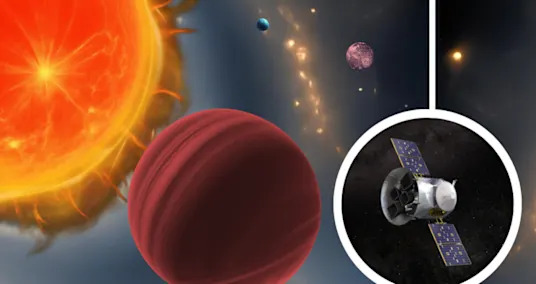
Astronomers have discovered over 100 new worlds beyond the solar system hiding in data collected by NASA's exoplanet-hunting spacecraft TESS (Transiting Exoplanet Survey Satellite), and it's thanks to artificial intelligence. The technique also identified a further 2,000 or so candidate extrasolar planets, or exoplanets, around half of which were hitherto undetected.
Considering that there are around 6,000 exoplanets currently in NASA's exoplanet catalog, confirming those candidate worlds would represent a major boost in our hunt for planets around other stars. The innovative new AI program behind this discovery is called RAVEN, and was developed by researchers at the University of Warwick in the U.K.
TESS spots exoplanets by recording the tiny dips in starlight they cause when they pass in front of the face of the parent star, a passage called a "transit." RAVEN studied TESS observations of over 2.2 million stars collected during the NASA spacecraft's first four years, hunting for planets so close to their home stars that they complete an orbit in just 16 Earth days. The AI pipeline could therefore help to confirm how common these tight-orbit planets are and the kind of systems in which they are most often found.
"This represents one of the best characterized samples of close-in planets and will help us identify the most promising systems for future study," team leader Marina Lafarga Magro of the University of Warwick said in a statement.
RAVEN's eagle eye is scanning the Neptunian desert
Since the first exoplanets were discovered in the mid-1990s, the exoplanet catalog has burgeoned to over 6,000 confirmed entries, but thousands of candidates identified by exoplanet-hunting space missions like TESS, Kepler and CHEOPS (Characterizing Exoplanet Satellite) remain unconfirmed.
That is because scientists need to determine whether small dips in starlight are actually caused by transiting exoplanets or if they have another, non-planetary cause. This means making these confirmations more rapidly and confidently is a major challenge that astronomers are eager to ease.
"The challenge lies in identifying if the dimming is indeed caused by a planet in orbit around the star or by something else, like eclipsing binary stars, which is what RAVEN tries to answer," RAVEN head developer Andreas Hadjigeorghiou of the University of Warwick said in the statement. "Its strength stems from our carefully created dataset of hundreds of thousands of realistically simulated planets and other astrophysical events that can masquerade as planets."
Hadjigeorghiou developer explained that the team trained machine learning models to identify patterns in the data that can tell astronomers the type of event that has been detected, something that AI models excel at. RAVEN is designed to handle the whole exoplanet-detection process in one go — from detecting the signal to vetting it with machine learning and then statistically validating it. That means that it has an additional edge over other contemporary tools that only focus on specific parts of this process, Hadjigeorghiou said.

"RAVEN allows us to analyze enormous datasets consistently and objectively," senior team member and University of Warwick researcher David Armstrong said in the statement. "Because the pipeline is well-tested and carefully validated, this is not just a list of potential planets — it is also reliable enough to use as a sample to map the prevalence of distinct types of planets around sun-like stars."
Within the candidate close-in planets, researchers could then determine the types of planets and their populations in detail. This revealed that around 10% of stars like the sun host a close-in planet, validating findings made by TESS's exoplanet-hunting predecessor Kepler.
RAVEN was also able to help researchers determine just how rare close-in Neptune-size worlds are, finding that they occur around just 0.08% of sun-like stars. This absence of these worlds close to their parent star is referred to as the "Neptunian desert" by astronomers.
"For the first time, we can put a precise number on just how empty this 'desert' is," leader of the Neptunian desert study team, Kaiming Cui of the University of Warwick said in the statement. "These measurements show that TESS can now match, and in some cases surpass, Kepler for studying planetary populations."
The RAVEN results demonstrate the power of AI to search through vast swathes of astronomical data to spot subtle effects.
The team's research was published across three papers in the journal Monthly Notices of the Royal Astronomical Society and is also available on the paper repository site arXiv.
NEUESTE BEITRÄGE
- 1
 Mont Blanc road tunnel reopens to traffic after 15 weeks of repairs12.12.2025
 - 2Wellness Bits of knowledge Readily available: A Survey of \Following Wellbeing and Progress\ Wellness Wearables10.08.2023
- 3Brilliant and Gleaming: Excellence and Skincare Practices06.06.2024
- 4Figure out How to Protect Your Gold Venture from Unpredictability19.10.2023
- 5When Would it be a good idea for you to Look for Help from a Criminal Legal counselor?30.06.2023
- 6Trump signs a law returning whole milk to school lunches14.01.2026
- 7Volkswagen Plant Could Pivot From Building Cars to Supporting Iron Dome Systems26.03.2026
- 810 Picturesque Campgrounds That Will Raise Your Outside Involvement with American05.06.2024
- 9Taylor Swift changes 2 song lyrics on 'Reputation' on the night of her Eras tour documentary premiere12.12.2025
- 10Artemis 2 breaks humanity's all-time distance record during historic loop around the moon (video)06.04.2026
- 11Find the Native Culinary Customs: Local Flavors13.07.2023
- 12She was the supermodel dubbed 'The Face' in the '80s. Joining OnlyFans in her 60s taught her a lot.11.12.2025
- 13South Africa pushes for $200B investment01.04.2026
- 1412 times rockets and spacecraft crashed and burned in 202529.12.2025
- 15Dancing through the crackdown: The satirical song soundtracking post-Khamenei Iran04.04.2026













Ähnliche Artikel
- Artemis 2 captures historic 'Earthset' photo | Space photo of the day for April 7, 202607.04.2026
- Tesla Germany Registrations Quadruple to 9,252 Vehicles in Best March Ever07.04.2026
- What's going on with Katseye? The Manon Bannerman hiatus drama, explained.07.04.2026
- Two IDF officers, civilian face indictment in alleged Gaza aid-truck smuggling scheme07.04.2026
- West Palm Beach Shorecrest, renderings of downtown waterfront condo07.04.2026
- Artemis II astronauts make long-distance call to the space station as they head home from the moon07.04.2026
- Tuesday, April 7. Russia’s War On Ukraine: News And Information From Ukraine07.04.2026
- The Eastern Bongo, Kenya’s Rare Forest Antelope on the Brink07.04.2026
- U.K. blocks Kanye West from entering Britain to headline now canceled festival: What led to the ban07.04.2026
- Russia confirms 16 Cameroonian soldiers killed in Ukraine war07.04.2026
- First Phosphate advances battery-grade phosphate project as analysts highlight strategic Federal support07.04.2026
- After fleeing past Hezbollah fighting, some Israelis on northern border vow to stay07.04.2026
- 'Unreal' solar eclipse: Artemis 2 crew just saw one of the rarest sights in spaceflight history07.04.2026
- Chinese construction workers in Israel: 'I’d rather be bombed than live in poverty'07.04.2026
- Broken toilet, T-shirts on windows and collecting saliva: The weirdness of daily life aboard Orion07.04.2026
- Czech Republic caps fuel prices amid Iran war energy crisis07.04.2026
- NASA releases stunning new images captured by the Artemis II moon mission, including 'Earthset' and a solar eclipse from space07.04.2026
- Amid Iran war, 53 of Israel's future scientists showcase projects in Jerusalem contest07.04.2026
- Iranian-linked drone attack kills Kurdish couple in northern Iraq07.04.2026
- Thousands of small fish defy gravity to climb Congo waterfall07.04.2026